Jonathan Stone, the reporter in The Solomon Scandals, grilled me for this Q. & A.—uncut. Last updated April 10, 2024.
STONE: Why’s Scandals copyrighted in your name? It’s my newspaper memoir.
ROTHMAN: Er, faux memoir. Without me, you wouldn’t even have been born…or have worked for the Washington Telegram…or have struggled to avert an IRS-CIA building collapse…or lived through those quirky sex scandals…or the corruption and blackmail from the Oval Office…or the gossip columnist’s suicide…
STONE: Thanks, but I’ve already read my book. Now what about the talking Afghan Hound at the Cosmos Club? Sure it doesn’t detract from my dignity?
 ROTHMAN: But you’ve been dead for decades by the time of Thackeray II’s performance at the Cosmos Club. Scandals is set mainly in the 1970s, but looks far beyond—via late-21st-century reflections from your great-grandniece at the Institute for the Study of Previrtual Media. Besides, Afghans are dignified. I didn’t put this detail in the book, but Thackeray II speaks in a wonderful baritone with a mid-Atlantic accent.
STONE: For latecomers, who’s this guy Solomon?
ROTHMAN: He’s the king of the landlords leasing office buildings to the General Services Administration, the government’s business agency. You might say he’s part of a crowd. A friend tears down row houses to make way for parking lots drawing noisy, not-so-nice visitors after dark. The near-by homes get sold, and then the Solomon crowd buys up the land for more high rises.
STONE: So I’m investigating Solomon. Is he inspired by someone in real life?
ROTHMAN: Latecomers can read on.
STONE: So people will know, just how real is the Washington Telegram?
 ROTHMAN: Very authentic in many of the details even though the Telegram is not the Washington Post or any other real-life newspaper. I worked on a daily newspaper for four and a half years, and, beyond that, I benefited from the advice of James Polk, a Pulitizer winner for his Watergate coverage for the old Washington Star. Don’t blame Jim for any flaws in the book—he wasn’t constantly looking over my shoulder as I wrote. But, yes, he was a big help for the first edition. I myself did my share of investigative journalism at the General Services Administration. I looked through 400 leases, including a rather minor one that GSA had with the Washington Star—for some warehouse space, I believe. Sen. Kennedy’s people were a big help on Freedom of Information matters.
 Just keep in mind the S word, satire. Despite all the genuine details, the Telegram in many ways bears about the same relationship to actual newspapers as the Union Broadcasting System in Network did to CBS, ABC or NBC. That said, the Telegram is closer to reality than either UBS in Network or the Daily Beast in Scoop. My novel broaches a number of genuine issues, such as the influence of business and government on the contents of newspapers and TV networks.
STONE: So you’re anti big media?
ROTHMAN: Only when they deserve it. I hate to see investigative reporting cut back by the current ad drought. Talk about ways to make newspapers wimpier! I wonder if many newspapers today would give you the time to check out Seymour Solomon. Yes, you have your tangles with George McWilliams, the sharklike editor; and he is of mixed mind—about your investigating his pal. But at least the Telegram has the money and spends it.
STONE: But isn’t investigative reporting happening on the Internet. Look at Josh Marshall’s site.
ROTHMAN: Do you really think bloggers and the rest will have the same resources as the old media? Yes, small guys broke stories like My Lai. But I’m talking about sustained efforts. I don’t think that wonderful foundations like the Sandlers’ can bear the entire burden, and just as with regular newspapers, funders will have to isolate their private interests from the activities of the editors and reporters they’re financing. That said, I’m in favor of whatever ethical business models work. I love ProPublica.
STONE: So did anyone follow up on your investigations?
 ROTHMAN: Actually yes, as my story about the late Sen. Abraham Ribicoff shows. Here’s a member of a GSA-related committee who held an investment of tens of thousands of dollars in a CIA-occupied building leased through GSA. And he hid behind a trustee and denied having any government-related investments. Then he continued his business relationship with the landlord involved on other properties. Jim Polk followed up on the NBC Nightly News and in the New Republic.
STONE: How’d you start digging through those 400 leases and discover that Abraham Ribicoff was a hidden investor?
ROTHMAN: An acquaintance of a family friend thought that Ribicoff and the business people involved were too chummy, and I acted on the tip. No one up to then had actually revealed Ribicoff’s role as an investor in a government-leased building—he steadfastly denied it. I got Ribicoff’s lawyer, the one behind the “blind trust,” to confess; too bad the Senate ethics committee kept dozing on.
STONE: No congressional investigation?
Actually, my work lead to an investigation on the House side, involving another GSA landlord. In the Case of Missing Cafeteria, a $500,000+ cafeteria went AWOL from the office building housing the headquarters of the Environmental Protection Agency. The lease called for one. But the cafeteria never materialized. The controlling owner was a well-connected Maryland Republican who moved in Spiro Agnew‘s circles. I broke the story in Federal Times, and Bettina Gregory picked it up for a great little segment on the ABC Evening News.
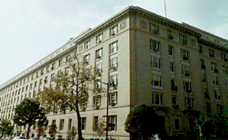 Of course, as is often the case, no one got punished. At least the investigators gave GSA (photo) a good scolding for being so lax about including the names of all partners in leases involving partnerships. It promised to do better. Would that I have time to follow up—and see if the bureaucracy has kept its word!
STONE: Didn’t you also write for the Washington Post about a guy named Solomon?
ROTHMAN: Joel Solomon, you mean—in a one-shot freelance piece: it wasn’t as if I were a Post regular. From the very start when I began the novel in the 1970s, I’d named my guy Solomon, and I wasn’t about to change it just because Jimmy Carter had the nerve to appoint a GSA administrator with the same last name. The Post was most emphatically not the Telegram in the Scandals novel. Susanna McBee on the National Desk was terrific and let me tell the whole story—namely that Carter had nominated a GSA landlord. In fairness to Carter and this Solomon, who is now dead, the ownership question ended up with a wonderful twist in this case. Joel Solomon’s GSA connections gave him more insight to fight corruption as a reformer at the agency. But we still needed to get the matter on record. By the way, I doubt many people would have confused Joel with Sy. This Solomon came from Tennessee. In the end, Joel Solomon left GSA ahead of time, apparently under pressure from the old guard there and their friends on Capitol Hill.
STONE: So what do you think of GSA these days?
ROTHMAN: I love GSA as story material even if I hate rip-offs of the taxpayers. Again and again over the years, the scandals keep popping up—to help your memoirs transcend time. Where else in government can you have people coming out against stricter safety standards for high rises in the event of another 9/11? And later there were issues with Donald Trump’s arrangement to lease a former post office building for a hotel. Stay tuned for more scandals if he reclaims the White House in the 2024 election.
STONE: Why do you make such a big deal of me being Jewish?
ROTHMAN: Great for the plot. Sy Solomon is a landsman, in a general way—an Eastern European Jew just like your maternal ancestors. If he were a WASP or an Asian Buddhist, it might be a little less challenging for you to investigate him. Your father, descended from old German-Jewish stock, is asking the classical question in effect, “Is it good for the Jews?” Understandably. Your parents came of age at a time when, for professional advancement, it was useful to change “Faberstein” to “Stone.” The main period in Scandals is the 1970s, but in many ways Herb and Lydia are still living in the ’40s and ’50s. Newspaper life is the main show in the book. But along the way, Scandals turns out to be a Northern Virginia Jewish novel in some respects. Oh, a little more about your last name. I actually gave it to you in honor of I.F. Stone, but as you can see, there’s a little more to the story than that.
STONE: And of course there’s the bank angle.
ROTHMAN: Exactly. Herb Stone just happens to work for a PR and lobbying firm repping a bank that’s loaned millions to Solomon and friends. Elton King, Herb’s boss, isn’t shy about dropping not-so-subtle hints. King’s a goy with enough nerve to invoke the bad-for-the-Jews argument himself. And meanwhile the bank angle leads to the heart attack angle. You worry your father will have another one.
STONE: You researched the cardiac details a little too well.
ROTHMAN: Yep, I didn’t expect to be fact-checking the medical scenes while in an ICU after a quad bypass. Three cheers for Dr. Rhee and his team at Inova Alexandria Hospital. They made this Web site possible through the simple act of keeping me alive.
STONE: What about the building collapse? You really had two professors advising you?
ROTHMAN: Details here. Gordon Batson and Kevin Parfitt really came through for me.
STONE: I can’t decide: are we speaking or e-mailing. I mean, do you really talk in hyperlinks?
ROTHMAN: Who cares, Stone? That’ll just have to remain one of the mysteries of the Web.
 STONE: Finally I need to ask you about that photo you’ve used at times for promo. Wasn’t it taken years ago?
ROTHMAN: So your latest insults have aged me that quickly? I’ve just updated the photo.
STONE: And I’m far more into the outdoors than you are. Why isn’t my photo up there? That way, the mountain background would be honest. Look, maybe I should be doing your publicity for you. Forget about Thackeray.
ROTHMAN: But never about you, eh? It takes a certain amount of ego to do investigative reporting. If nothing else, you’ve aced that part.
Note: This page was started in November 2008. I made some tweaks on November 16, 2010, July 3, 2023, Oct. 27, 2023, and April 10, 2024.
Discover more from The Solomon Scandals
Subscribe to get the latest posts to your email.


