
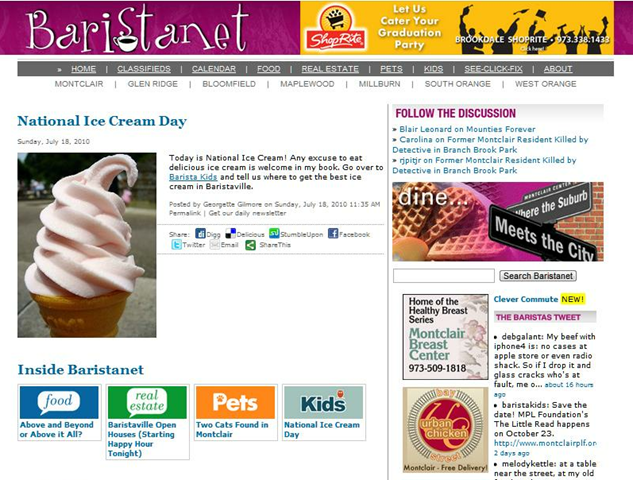
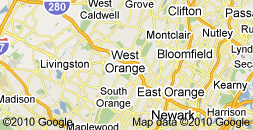
 In 2004 Baristanet—the lively hyperlocal network that helped inspire similar operations in several states—started writing up picnics, schools and other neighborly news in Essex County, NJ.
Some five years later, The New York Times set up shop with blogs for Maplewood, Millburn and South Orange, all in the same county.
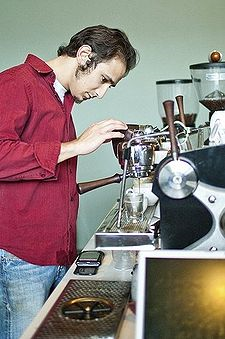
Last month one of the two hyperlocal nets said good-bye to its readers and graciously offered a Web link to the other people’s site. No, the farewell didn’t come from little Baristanet, one of whose co-owners is Debbie Galant (photo below), a former New Jersey columnist for the New York Times.

 Both online and in an interview with On the Media, the Times goliath did its best to downplay the shutdown, depicting the year-old New Jersey Local sites as an instructive experiment, which in fact it had been all along. What’s more, the Times is continuing hyperlocal efforts in the Fort Greene and Clinton Hill sections of Brooklyn, in partnership with the CUNY Graduate School of Journalism, and it also will be working wiith New York University on The Local: East Village. Furthermore, Deputy Metro Editor Mary Ann Giordano told OTM that the Times might pick up content from other people’s local blogs—perhaps Baristanet?—if they met certain standards. Still, do you really think the Times would have closed its New Jersey Local blogs if the Essex County experiment had taken off?
 What the devil happened? Any lessons here for the Washington Post to learn from the Times’ hyperlocal shutdown in New Jersey? The Post has already chalked up a hyperlocal failure in Loudoun County, VA, and now faces competition from TBD.com, a hyperlocal startup overseen by Jim Brady, the ex-editor of Washingtonpost.com. In certain ways might this be a repeat of what happened when two L Streeters left to start the Politico, now a staple on the White House’s daily reading list? Here’s another twist. TBD’s owner is Allbritton Communications, which had family ties with the late Washington Star and owns WJLA-TV and NewsChannel 8, with which TBD will be teaming up.
 How, then, can the Washington Post’s editorial and business sides protect L Street’s franchise as the main local news source for the D.C. area? TBD aims to cover the news and make money, not destroy the Post, just as tiny Baristanent won’t exactly kill off the New York Times. Still, in the aggregate, independent hyperlocal operations could siphon off a noticeable amount of revenue from Post- and Times-style newspapers, especially if they can draw readers and advertisers from a whole metro area as TBD intends to. Let’s analyze what may have happened in Essex County, then ponder how the Post might fare better next time it goes hyperlocal. Many of my thoughts may also apply to the Times, which, after all, is still committed to hyperlocal experiments.
In my opinion from afar, here’s why Baristanet still thrived but the Times failed to score big with its hyperlocal network in Essex County:

 1. The Times kept on its business suit, so to speak, and failed to acquire a truly casual look for the suburbs. The Times sites struck me as more professional, more structured; Baristanet’s, as friendlier.The homegrown operation has more photos and its share of videos, and looks like a high-tech family album. I know. “Eye candy” is what techies and some journalist might dismiss Baristanet’s colorful layout as being. But approachability counts endlessly on the Web. Hyperlocal sites and pages need to be designed for their particular readers, not just as reinforcements of the brand images of the mother ships. Baristanet itself, by the way, appears to be named after the coffeehouse baristas. Talk about a warm image and appropriateness! “Barista” can also mean “bartender” in Italian, and that’s likewise fitting, considering the many Italian-Americans in New Jersey.
2. Baristanet is better plugged into Essex County through people such as Debbie Galant, or at least that’s how it came across to me online. The Times drew its share of local contributions and for all I know had some locals managing it, but its style and approach seemed just a little more detached. New Jersey Local ran a “Virtual Assignment Desk” feature where you could sign up to do coverage. But Baristanet did a better job of baking the participatory angle into itself in an ongoing way. When Baristanet served up words and images from Montclair High School’s reunion, it asked the picnic attendees to “tell us who you saw. Or regale us with memories of your days at 100 Chesnut.” Simply put, Baristanet has better positioned itself as a place for chatty neighborhood conversations, as opposed to stiffer, more formal coverage.
I wonder how easily the New York Times and the weekly Montclair Times can match Baristanet someday in its skill in at drawing out the Essex County locals. Check out this YouTube video from dkennedy56 where Baristanet and the Montclair paper offer starkly different philosophies of news coverage. Like both Times, I want substantive coverage of civic matters, but the Montclair paper’s strategy of focusing on process—on, say, detailed coverage of government meetings—needs new wrinkles to appeal to Web-era readers.
3. The Baristanet operation has more focus than did the New York Times’s hyperlocal efforts. Baristanet does not just home in on well-off communities rather than worrying about places like Newark. In story choice and story placement, this seems in some ways like an upscale female-oriented lifestyle section in disguise. See a Baristanet adkit showing that 63 percent of Baristanet readers are women and 39 percent have yearly incomes exceeding $150K. The Times had geographical focus, but the targeting still was not as precise, even with some stories aimed at affluent women. To be sure, I have mixed feelings about this. Consider the social implications of hyperlocal suburban operations competing with daily newspapers also serving not-so-wealthy areas such as Newark. Baristanet’s typical reader is hardly a multimillionaire, but we’re still talking about lower-hanging fruit than in Newark. Kudos to the Times for its hyperlocal experiments in a socially mixed section of Brooklyn. One aside: Perhaps hyperlocal sites could use cookie-based customization or other schemes to be have different focuses for different readers, beyond geo-based ones.
 4. The New York Times didn’t sufficiently recognize the close relationship between news and advertising and pay enough attention to the business side—the ad people more or less sat on the sidelines, even though I did notice some advertising in the Times’ New Jersey blogs when I looked this week, including some from Google. Baristanet was and is well stocked with ads on its home page at least; and I doubt that its reach of “more than 9,000 visits a day” is the only reason. Once again we’re talking about focus on the lifestyles of the not-quite-rich-but-well-enough-off. Mind you, a hyperlocal network shouldn’t be an online shopper, with oily tributes to local merchants advertising there, and in fact, in The Solomon Scandals, I write of a fictitious newspaper where business goals compromise the editorial ones. But the Baristanet is full of upbeat headlines, on food festivals and the like, that appeal to its target audience even if the stories are not necessarily about advertisers per se. Debbie Galant claims in the YouTube video that her company is already making money, and I can believe her although I doubt the sum is huge. Her father ran a newsletter in Washington, D.C., so entrepreneurship, not just journalism, is in her blood.
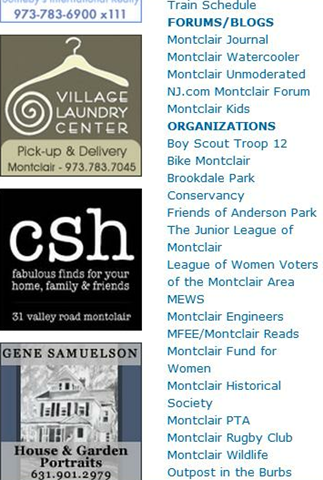
5. Although Times’ hyperlocal operation in New Jersey blogrolled other local sites, Baristanet’s home-page list was far more detailed and useful. In effect, it made itself a good reference source—for new and old residents alike—rather than just a bulletin board and virtual watering hole. Whether you’re a gardener or a cancer survivor looking for others, Baristanet can help. The above image on the left shows just a fraction of the links running along the right column of the Baristanet site’s home page. The link collection serves another purpose, in positioning Baristanet as a a hub, as an online institution, rather than just another local blog. Along the way, do you notice the tasteful, well-done local ads?
My recommendations for the Post and the Times
All this is highly applicable to the New York Times and Washington Post, whose traditional corporate and editorial cultures could hurt them if the people in charge doesn’t change. The Post will need to master the art of online conversation—not just good writing and reporting—and partner with the local blogging community in a much bigger way than it has so far. Q & A’s with staffers and newsmakers aren’t the same for bloggers and other readers as are genuine partnerships. Like Baristanet, the Post should bake in the conversation on local topics rather than add it as frosting. Baristanet is not claiming that its stories provide full coverage. Rather, the idea is to start a dialogue. As best I can determine, TBD’s people feel the same.
 One way or another, TBD is out to rewrite the rules of local coverage for the D.C. area. It will rely on a mix of its own staff reporting and links to local blogs. In the OTM interview, the Times’ Mary Ann Giordano correctly notes the amount of energy and time that professional hyperlocal journalism can demand, and I’m not certain that a staff of some 50, the size envisioned for TBD’s launch in the Washington area, will be enough for both thorough coverage and complete fact-checking. The good news is that TBD is trying to adapt Web interactivity to journalists’ traditional focus on getting at the truth, complete with the details. I love the headline over a TBD blog item today and hope that the people there can keep their word: TBD is committed to accuracy; help us correcct, verify.
TBD Community Engagement Director Steve Buttry (photo) and Editor Erik Wemple write: “A box will accompany most TBD articles under the banner ‘Complete This Story.’ It’ll prompt users to tell us what’s wrong, and it’ll also note the story’s weaknesses as identified by editors and reporters at TBD, inviting you to help us fill the holes.” Great! When I ran an e-book blog, I, too, played up readers’ comments and encouraged our visitors to correct us and add missing facts. The old paradigm—of journalists as infallible souls—is out of date. Readers are wise. Whether in hyperlocal coverage or other kinds, the Post and the Times will have to adjust. The quest for truth needs to be less one-sided—more of a genuine dialogue. Virtually all of daily journalism, even the New York Times’, is like a sausage factory, because it’s done on deadline. TBD is simply being straightforward about human frailties.
Here are some of my other recommendations, beyond striving for genuine dialogue with readers and trying to be transparent, the way TBD is:
#1: Both the Times and the Post are repairable at the local level and may even have certain advantages: Use them
 It isn’t as the Times and Post are staffed by net.dunces. Mary Ann Giordano, Times deputy metro editor who’s overseeing hyperlocal efforts, has hundreds of Facebook friends, and although her New Jersey sites weren’t quite as well targeted as Baristanet’s, they had their share of positives.
Just as significantly, the big boys have more resources on both the editorial and business sides. In the Post’s place, I would home in on the big weakness of TBD’s strategy—its heavy dependence on local bloggers, just a fraction of whom are writing civic-oriented items. I would resign myself to some heavy short-term losses and either deploy staff to start local blogs or invest heavily in independent local sites or try a mix of these strategies. Go for in-depth hyperlocal coverage of education and zoning and other areas where TBD right now is weak. While the Post has started a local blog network, it is too small to be of any real consequence compared to what TBD envisions for itself.
On the business side, I would go after ads from national companies with a major local presences such as McDonalds, so that advertising support from the Post came with the territory when bloggers signed up to help stock hyperlocal editions.
I would also work to package both the main paper and the hyperlocal offshoot or offshoots as slickly as possible. In PR terms and even legally, it would be a disaster if the Post launched a war on local links. But just like the Times, L Streeters can hire better Web help than hyperlocal competitors can, and the Post could go on to build thriving communities of forum participants and blog commenters, so that the Post-related sites are genuine destinations, not just fodder for links and summaries from TBD and the Allbritton blog network’s affiliates. What’s more, I would strike alliances with phone companies and Google so that the Post provided well-packaged, location-aware coverage for those wanting it—and of course the accompanying ads.
Yet another issue is contract exclusivity with bloggers. I’d rather this not happen, but just out of curiosity, I wonder if is there a way, without breaking anti-trust laws, for the Post to require some kind of exclusivity. Given all its cash from Kaplan, the Washington Post Company could probably survive a bidding war nicely. The downside of this is that a war could significantly jack up expenses, and besides, as noted earlier, nasty issues may emerge when you try to make use of links exclusive (exclusivity for full reproduction of content is a different matter). My own belief is that severe copyright restrictions would hurt everyone, even large conglomerates, whether they realize it or not.
In another area, if I suddenly took over the Post’s local operations, I would make use of my resources to implement the database concepts described earlier in the Solomon Scandals blog. Yes, TBD could set up databases of its own—for its staffers and affiliates. But if the Grahams really care, the Post will have the resources do out-database TBD.
I don’t know the precise capabilities of the Post’s technical staff to set up the infrastracture for a hyperlocal initiative, but if the right people are not in-house, I would hire them. Come on, Don Graham. The money is there. If you don’t want to invest your Kaplan cash in the right people and technology for a decent local news operation, maybe you need to think about selling off the paper.
Finally, as long as we’re discussing advantages of the big boys, I wonder if the Post could team up with a TV station to counter TBD’s relationship with WJLA and NewsChannel 8..
#2: Strive for a good balance of the light and the serious in a way that draws in readers: Improves their lives—and maybe even save them
What kind of hyperlocal news should the Post and Times focus on? I favor a mix. Who says the serious can’t be as compelling as the frivolous and maybe even more so? TBD affiliate Beth Solomon’s first-hand write-up of her experience as a crime victim—in the very territory covered by her Georgetown Dish—is one example. Here’s another.

 Readers already know of my interest in highway safety—I’m the guy whose first published commentary in his high school paper was an appeal for a traffic light at the intersection of Gum Spring Road and Route One.
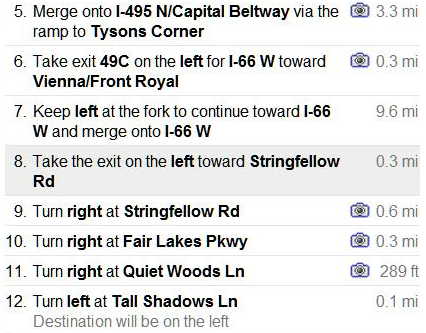
Now what about my harrowing experience on Interstate 66 yesterday with Google Maps when I went out to Fairfax, Virginia to pick up a used iPod I’d bought through Craigslist? When I was on my way to the seller’s house, Google couldn’t have been clearer, as these two images from screenshots show. Google told me to turn left from I-66, then head right on Stringfelllow Road. No mention that the Stringfellow Road was gated off at the time I was travelling, Sunday morning!
 So what happened? Well, I know that Google has warnings that it is not infallible, but you’d expect road directions to be updated regularly. So here I was cruising along in a 1988 Honda and was just at the level for a beheading if I went through the gate. It was daylight, so I spotted the threat in time—but with a little difficulty just the same, because of the confidence that a computerized map gave me, deserved or not. Talk about cognitive dissonance! What’s more, suppose it had been night, the warning lights on the gate had been working, but it was hard to judge the distances involved. And meanwhile cars were whizzing past me at perhaps 75 miles per hour, easily over the limit—I-66 is really NASCAR in disguise.
Notice all the angles here? The first-person story—or reports of others’ experiences—could be just the start for a good hyperlocal blogger. How about contacting Google and the government officials responsible for I-66. Is there any coordination? If Google isn’t getting timely updates from the highway people, should it seek them out and maybe even press for daily ones? I think so, and by way of disclosure, I’m more than a little annoyed at the company despite being a very small long-term shareholder for retirement purposes. The I-66 incident, had it happened at night, might have deprived me a chance even to live to retirement. Also, why the need for the gate? Some kind of HOV arrangement? And what about the classic I-66 issues? Who counts the most, local commuters or tourists and truckers? In places, thanks to some dummies in Richmond or elsewhere, parts of I-66 lack a safety shoulder at times, so an SUV could give your body a good bloodying if you’re in the wrong place after your car breaks down.
All kinds of I-66-related angles emerge, in other words, some associated with my little experience, some not; and I’ll be disappointed if TBD and the Post offer us hyperlocal fluff at the expense of bread-and-butter issues like highway safety. Balance, please! Not one extreme or another. Public service journalism, rather than just coverage of picnics and cupcake tastings, could provide good hyperlocal blogs with a halo effect and actually help bring in advertisers. So can fluff. bBut balance might be still more effective.
Quite rightly, Baristanet has pointed out that traditional investigative reporting can be inefficient, and in fact I myself am resigned to less-than-perfect coverage of individual issues in order to cover more territory for readers. But as you’ll see in Item #3, there are ways to improve efficiency and reduce the costs, by way of databases and crowd-sourcing. The Post itself has already been experimenting with crowd-sourcing of some documents, whose major points readers can help home in on.
#3: Give readers the source material, so they can track the procedures of government—but keep your eye on the results
In line with the above, I’d suggest that hyperlocal operations first decide what counts most in people’s lives—safe highways, good schools, livable neighborhoods and the rest—and work backwards to determine the nature of government-related coverage. Focus on both possible outcomes (alerts for readers about items on official agendas) and actual outcomes (board votes, etc.). Then ask such questions as: Who are the people behind the mess on I-66? Their names? Their contact information? Which government agencies, boards, etc., are responsible? How to track their actions and possible actions, including important items on agendas for votes?
The right databases with this information could save the time of both bloggers and professional staffers and enable them to alert the citizenry in timely ways. If the organizations can share the information with citizens, then so much the better! Give them toolboxes for action!
If nothing else, I’d like to see powerful news organizations like the Post and the Times editorialize and otherwise pressure city and county governments into getting as much information online as possible in a truly timely way that would serve the public interest. That would include summaries and even full transcripts of meetings, which will be easier and easier to offer as speech recognition grows in accuracy (we’re not there yet). Then the networks could more easily crowd-source the information to readers, providing them with handy explanations of the information via hyperlinks so that it was in context. Home page recognition and other rewards could go to the most helpful participants. Crowd-sourcing isn’t a replacement for old-fashioned shoe-leather reporting but could save newsroom resources.
As for city budgets, I don’t just want them online—I’d like to see them hyperlinked to plain-English explanations of expenditures. If the cities won’t annotate helpfully, then that’s one more task for hyperlocal networks and their affiliates, perhaps through crowd sourcing in cooperation with civic associations and others.
#4: Cherish reporting that reflects actual neighborhood surroundings
Detachment from physical surroundings—that’s a fear I have about too heavy a reliance on hobbyist and sports-oriented blogs, as to genuine neighborhood-oriented ones.
I’d actually like to see alliances between hyperlocal news organizations and Wikipedia, which offers a surprising number of items about local landmarks and institutions. Check out Wikihood’s site—promoting an iPod and iPad app—for a hint of the possibilities. I don’t just want to see newspaper libraries just put online in full: I’d like to see them keyed better to physical surroundings. Granted, many newspapers love to challenge the accuracy of Wikipedia, but they could always alert readers or offer vetted versions of its content. And speaking of physical surroundings, how about possible alliances with Google Maps-style outfits, too, the I-66 goof not withstanding?
#5: Don’t just limit blogger recruitment efforts to existing bloggers
Trouble finding bloggers with in-depth knowledge of issues and a willingness to take the time to cover them well? Then look for genuine experts, passionate about their topics, and teach them to write if they can submitting promising samples. Say, the subject is education, an area where TBD laudably admits it’s weak. I’d suggest that TBD or the Post check out a former ABC producer who, as far as I know, isn’t an educator but who is a genuine numbers geek and loves to analyze the test scores of Fairfax County students. A teacher friend of mine recommended her. The ex-producer was president of her PTA. A most promising mix of qualifications, if my information is accurate. While TBD and the Post can get up to speed most quickly with existing bloggers, it’s important to build for the future and perhaps adjust business models and contract terms accordingly. With more resources, news organizations like the Post and Times could enjoy an advantage in blogger recruitment, just so they treated the recruits well and trained them for the job.
Well, I’ll stop now and send the Web address of this post to Baristanet, the New York Times, the Montclair Times, TBD and the Washington Post for their own perspectives, if they care to offer them in this blog’s comments area. Let the conversation start (or—in TBD’s case, given our useful existing dialogue—continue).
Meanwhile, another reminder: I hope that both the Post and TBD will thrive; and I won’t favor either side. Like the other posts, this one is about strategy, not about whether the Post or TBD deserves to win.
A few related items, in case they don’t show up automatically below via one of my favorite WordPress plug-ins: How TBD could use hyperlocal journalism to kick the Washington Post’s butt; How TBD Web startup in the D.C. area will work with affiliated bloggers; and TBD, meet the Westside Independent: Role model for SOME neighborhood blog affiliates?
Update, July 20: Also see TBD’s links to blog posts about the startup, including this one and other uppity stuff I’ve written. Thanks, guys.
Discover more from The Solomon Scandals
Subscribe to get the latest posts to your email.


Thanks for your continuing interest, David. I share your hope that the Post and TBD will both thrive. We welcome your suggestions, whether directed at us or others.
You’re welcome, Steve. Let a thousand flowers… And thanks, meanwhile, for understanding that this post was a strategizing exercise and I remain neutral. Continued best wishes to all on the hyperlocal scene. David